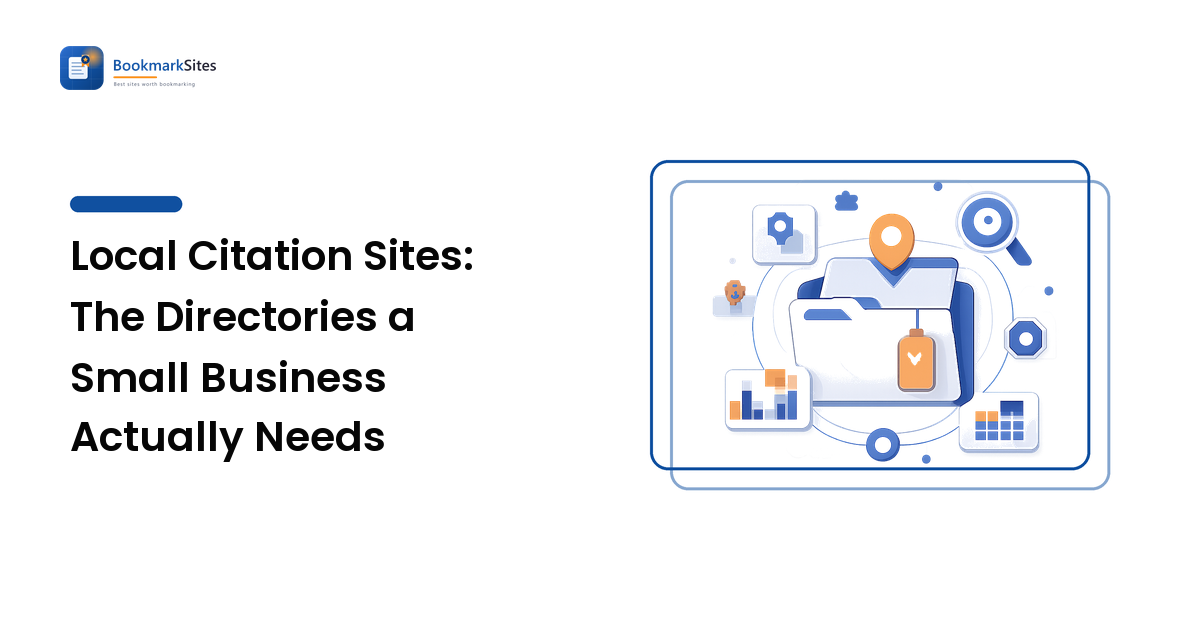
If you run a local business — a clinic, a plumbing outfit, a coffee shop — you've probably been told to "get listed everywhere." It's mostly wrong. There's no prize for appearing in five hundred directories, and most of them send nobody. What actually helps is a much shorter list of citation sites: places that publish your business name, address, and phone number (your "NAP") in a form search engines and map apps trust. Get those right and consistent, and you become easier to find in the moment someone nearby is looking for what you sell.
The takeaway up front: a handful of the right citation sites, all showing identical details, beats a mass-submission blast every time. Here's which sites actually matter, why consistency is the whole game, and how to get it done without drifting into spam.
What a local citation actually is
A citation is any online mention of your business's core details — name, address, phone, and usually a website and category. Some are full listings you create (a Google Business Profile, a Yelp page); others are passing mentions on a local blog. Search engines use the consistency of these mentions as one signal that your business is real, established, and located where it claims to be. That's the job a citation does: it corroborates you.
This is the one area where directory-style listings still do measurable work, even when general web directories mostly don't. For the broader picture of how listing sites earn or lose their value, the web directories guide covers the scoring habit; here we're focused on the local slice.
The citation sites that actually matter
Think in tiers, not in volume. A small business gets nearly all the benefit from these:
The map and search platforms
These are non-negotiable because they are the search surface for local intent:
- Google Business Profile — the single most important listing you own. It feeds Google Maps and the local pack, and it's free to claim.
- Apple Business Connect — controls how you appear in Apple Maps, which is the default on every iPhone.
- Bing Places — smaller reach, but quick to claim and it feeds Bing and some voice assistants.
The data aggregators
A few large data providers syndicate business information out to dozens of downstream apps, GPS systems, and directories. Get your details right with the major aggregators and a lot of secondary listings inherit accurate data instead of stale nonsense. You won't see these in daily searches, but they quietly shape what everyone else shows.
The major general directories
A short set of high-traffic, genuinely-visited directories where real customers read reviews and click through — the well-known review platforms and the big social business pages. These earn their place because people actually use them, not because they promise "backlinks."
Industry and local directories
Then, and only then, a few directories specific to your trade or your town: a professional association, a local chamber of commerce, a respected city guide. One relevant niche listing outperforms fifty generic ones, because the audience is already the right one.
Notice what's not on the list: sprawling auto-approve directories that exist only to host links. They don't send customers, and sitting alongside spam does you no favors.
Consistency is the whole game
Here's the part people underestimate. It's far more valuable to appear on twenty sites with identical details than on two hundred with small variations. "Ste 200" on one and "Suite 200" on another, an old phone number lingering on a third — those mismatches make it harder for search engines to trust you're one real, stable business.
So before you list anywhere, write your NAP down once, exactly as it should appear, and paste that same block everywhere. When something changes — you move, you re-brand — the tedious part isn't the change itself, it's tracking down every listing so they stay in agreement.
Doing it yourself vs. having it done
Claiming your Google, Apple, and Bing listings is genuinely a do-it-yourself afternoon, and every local business should own those accounts directly. The grind is everything after: creating and verifying accounts across the aggregators and second-tier directories, entering the same NAP by hand dozens of times, then going back to refresh them later. It's not hard work, but it's slow, repetitive, and easy to abandon halfway — leaving you with the inconsistent footprint you were trying to avoid.
If that's the wall you keep hitting, it's reasonable to hand the repetitive listing work to someone who does it all day. A well-reviewed local-SEO specialist on Fiverr builds citations across established USA business directories and Google Maps, and can handle ongoing small-business social promotion too — useful because a maintained social presence gives those listings somewhere active to point. This fits a small business specifically because you keep the strategy and your core profiles, and buy back only the hours of form-filling and consistency-checking. Keep the discipline that protects you — brief them with your exact NAP, ask for real, relevant directories rather than a giant volume count, and start with a small batch you can verify before scaling.
FAQ
How many citation sites do I really need?
Fewer than you'd think. Nail the map platforms, get correct with the major data aggregators, add a short list of high-traffic general directories, and a couple of genuinely relevant industry or local ones. That covers almost all the benefit; chasing hundreds of generic directories adds risk and busywork, not customers.
What's the single most important listing?
Your Google Business Profile, by a wide margin. It drives Google Maps and the local pack — the results most people see first for "near me" searches. Claim it, verify it, and keep it complete before you touch anything else.
Is paying someone to build citations safe?
Paying for the labor of submitting accurate details to legitimate, relevant directories is an ordinary operational choice — you're buying time, not manipulating rankings. The risk lives in quality and intent: relevant listings with consistent NAP on real platforms are fine; buying "500 directories guaranteed" is the mass-submission spam to avoid. Judge the work by whether the listings are live, accurate, and on sites real people use.
Next step
Write your NAP once, exactly right, and claim your Google, Apple, and Bing profiles yourself. Then build a short, scored list of the aggregators and directories that actually reach local customers — and either work through them carefully, keeping every entry identical, or hand that repetitive listing (and ongoing social promotion) to a local-SEO specialist so it gets done consistently. A week or two later, search your business name plus your city and keep only the listings that show up correct and send real visitors. A few accurate citations on sites people really use will do more for a small business than a thousand listings nobody reads.